
Home
Distinguished Flying
Cross
|
This medal is awarded to any officer or enlisted man of the
Armed Forces of the United States who shall have distinguished himself in
actual combat in support of operations by "heroism or extraordinary
achievement while participating in an aerial flight, subsequent to November
11, 1918." The decoration may also be given for an act performed prior
to November 11, 1918, when the individual has been recommended for, but has
not received the Medal of Honor, Distinguished Service Cross, Navy Cross, or
Distinguished Service Medal. The Distinguished Flying Cross, authorized by an Act of
Congress of July 2, 1926 (amended by Executive Order 7786 on January 8, 1938),
was awarded first to Captain Charles A. Lindbergh, of the U.S. Army Corps
Reserve, for his solo flight of 3600 miles across the Atlantic in 1927, a
feat which electrified the world and made "Lindy" one of America's
most popular heroes. The first D.F.C. to be awarded to a Navy man was to
Commander Richard E. Byrd, of the U.S. Navy Air Corps, on May 9, 1926, for
his exciting flight to and from the North Pole. Both these famous aviators
also received the Medal of Honor with the Distinguished Flying Cross. The
Aviatrix Amelia Earhart also received the Distinguished Flying Cross. Hers
was the only such award, as an executive order on March 1, 1927, ruled that
D.F.C. should not be conferred on civilians. During wartime, members of the Armed Forces of friendly foreign
nations serving with the United States are eligible for the D.F.C. It is also
given to those who display heroism while working as instructors or students
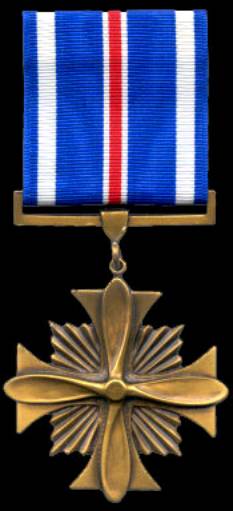
at flying schools. The Distinguished Flying Cross was designed by Elizabeth Will
and Arthur E. DuBois. It is a bronze cross pattee, with rays between the arms of the cross. On the
obverse is a propeller of four blades, with one blade in each arm of the
cross and in the re-entrant angles of the cross are rays which form a square.
The cross is suspended by a rectangular-shaped bar and centered on this is a
plain shield. The reverse is blank and suitable for engraving the recipients
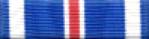
name and rank. The ribbon has a narrow red center stripe, flanked on either
side by a thin white stripe, a wide stripe of dark blue, a narrow white
stripe and narrow dark blue at the edge of the ribbon. Subsequent awards of the Distinguished Flying Cross are
indicated by oak-leaf clusters for Army and Air Force personnel and by
additional award stars for members of the Naval services. An example of the gallantry
for which the Distinguished Flying Cross is awarded took place on the morning
of August 31, 1969 in Vietnam. Captain Francis J. Cuddy,
USMC a Helicopter pilot, was assigned the mission of assisting in the
extraction of an Army Special Forces reconnaissance team heavily engaged in
combat with a large North Vietnamese Army deep in a mountainous area under
the enemy's complete control. Captain Cuddy,
undaunted by the heavy volume of hostile fire directed at his aircraft,
directed other helicopters into the area, moved his aircraft into treetop
level and delivered repeated rocket and strafing runs on the enemy positions.
As a result of his devastating attacks, the hostile fire was suppressed and
sufficiently to enable the transport helicopters to safely extract the
reconnaissance team. The citation for his award went on the say ". .
.Captain Cuddy's courage, superior airmanship, and
unwavering devotion to duty in the face of personal danger were instrumental
in accomplishing this hazardous mission and were in keeping with the highest
traditions of the Marine Corps and of the United States Naval Service."
Captain Cuddy was also awarded the Silver Star,
three Distinguished Flying Crosses, Commendation Medal with Combat
"V," the Purple Heart and forty eight Air Medals During his tour of
duty in Vietnam. Authorized Device: Oak leaf Cluster |
Home